
Nobody puts “learning how to file taxes” on their OnlyFans creator bucket list.
It's usually more like:
Make content. Get subscribers. Earn money. Buy something nice.
Simple, right?
Until tax season arrives and suddenly, you're staring at your earnings like they've personally betrayed you.
Wait. I have to pay taxes on THAT too?
Welcome to the less glamorous side of content creation.
The cameras are off, the ring light is unplugged, and your accountant is about to become a very important person in your life.
Because making money on OnlyFans is one thing.
Knowing how much of it you actually get to keep? That's another story.
1. Yes, OnlyFans Income Can Be Taxable
Let's get the biggest question out of the way.
Do OnlyFans creators have to pay taxes?
Generally, yes.
Money earned from subscriptions, tips, paid messages, and custom content can count as taxable income.
It doesn't matter whether creating content is your full-time job or something you do on weekends.
If you're earning money, your local tax authority may expect you to report it.
The exact rules depend on where you live, how your business is structured, and how much you earn.
But here's something worth remembering:
A side hustle isn't automatically a tax-free hustle.
According to the IRS, income earned through gig-economy platforms generally must be reported, even when it's part-time work or no tax form was issued.
2. OnlyFans Isn't Your Personal Tax Accountant
Here's where some new creators get confused.
OnlyFans processes payments and takes its platform fee, but that doesn't mean your personal income taxes are automatically taken care of.
In many situations, creators are responsible for tracking their earnings, reporting their income, and paying the taxes they owe.
Think of it like running a small business.
Except instead you're selling access to your content.
And just like any other business owner, you need to know what comes in, what goes out, and what belongs to the tax office.
Sorry. Your ring light can't help with this one.
3. The 20% OnlyFans Fee Isn't Your Income Tax
Let's say a fan spends $100 on your content.
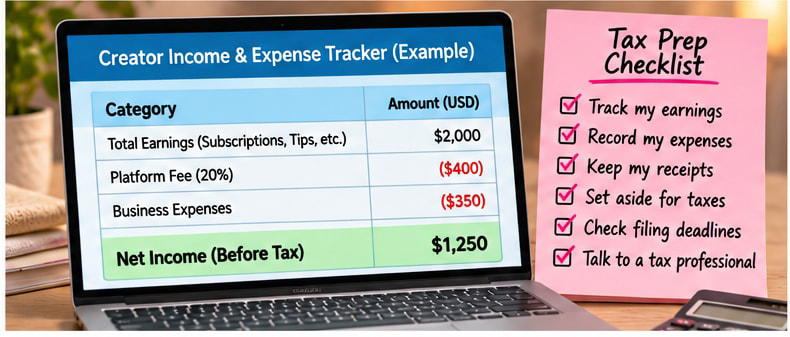
Under OnlyFans' standard revenue arrangement, the platform retains 20%, leaving the creator with $80 before applicable taxes and other expenses.
Sounds straightforward, right?
But here's the important part.
That $20 is a platform fee, not a payment toward your personal income tax.
Depending on your country's accounting and tax rules, you may need to record the full customer payment and account for the platform fee separately.
That means the $80 arriving in your account isn't necessarily $80 you can spend without another thought.
Some of it may need to be saved for taxes.
Yes, even if you've already mentally spent it on a weekend getaway.

4. You Might Be Considered Self-Employed
Many OnlyFans creators operate as independent businesses rather than traditional employees.
That can mean handling responsibilities an employer would normally help manage.
For example, in the United States, creators operating as sole proprietors may need to report business income and expenses on Schedule C.
They may also owe self-employment tax, which is separate from federal income tax.
In other countries, creators may need to register as self-employed, declare business income, or meet other reporting requirements.
The details vary.
But the basic lesson is the same.
Being your own boss also means being your own paperwork department.
5. What About Tips and Paid Messages?
A subscriber sends you a $20 tip.
Another pays for a private message.
Someone else purchases a custom video.
Does all of that count?
Generally, payments you receive in exchange for your content or services can form part of your business income.
And calling something a “tip” doesn't automatically make it tax-free.
It's worth keeping track of every type of earning, including subscriptions, tips, paid content, and other creator-related payments.
Why?
Because small amounts add up.
And trying to reconstruct a year's worth of transactions from memory is not a fun.
6. Can OnlyFans Creators Claim Business Expenses?
Now for the part everyone likes a little more.
Tax deductions.
Depending on your local tax laws, certain expenses connected to running your creator business may be deductible.
Examples might include:
- Cameras, lighting, and recording equipment
- Editing software and subscriptions
- Advertising and promotional expenses
- Business-related internet and phone costs
- Professional accounting or bookkeeping fees
- Certain props and supplies used for content production
But before you start calling every shopping trip a business expense, there's a catch.
An expense usually needs to meet the relevant business-use requirements.
A camera used exclusively for content creation is easier to justify than a handbag you wear everywhere.
And if you use something for both personal and business purposes, only the eligible business portion may qualify.

7. What If You Only Make a Little Money?
Maybe you're not earning thousands every month.
Maybe you made $50 last week and $100 this month.
Does that mean you can ignore taxes?
Not necessarily.
Tax obligations don't always begin at the same amount, and income reporting requirements can differ from the rules for actually owing tax.
In the United States, for example, people with at least $400 in net earnings from self-employment generally have a federal filing obligation related to those earnings.
Other filing rules can apply, too.
Even when you don't owe much—or anything—it's still worth keeping proper records.
A small creator business can grow.
And it's much easier to organize your finances from the beginning than to untangle them two years later.
8. Do You Need to Save Money for Taxes?
In many cases, yes.
One of the biggest mistakes a new creator can make is treating every payout as spending money.
Imagine earning $2,000 in a month, spending it all, and then discovering you owe taxes on your profits.
Suddenly, that shopping spree doesn't feel quite so fabulous.
A practical approach is to regularly move some of your earnings into a separate savings account for future tax payments.
How much should you save?
That depends on your country, total income, deductible expenses, and personal circumstances.
There isn't one percentage that's right for everyone.
A qualified tax professional can help you estimate an appropriate amount.
Think of it as paying your future self a favor.
9. Keep Your Receipts. Seriously.
Nobody wants to hear this, but good recordkeeping can save you a lot of trouble.
You don't need a fancy accounting system on day one.
A simple spreadsheet may be enough to get started.
Keep track of:
- Your earnings and payout statements
- Platform fees
- Business-related purchases
- Receipts and invoices
- Advertising expenses
- Relevant tax documents
- Any payments you've already made toward taxes
It's also useful to separate personal spending from business spending wherever possible.
That way, when tax season arrives, you're not scrolling through hundreds of transactions wondering whether a $79 purchase was for work or just a very enthusiastic online shopping session.
We've all been there.
10. Will the Tax Office Know About Your OnlyFans Earnings?
Here's a question some creators are probably afraid to ask.
What if you simply don't report the income?
Bad idea.
Depending on the country, payment platforms and financial institutions may have reporting obligations.
Tax authorities may also obtain information through financial records and other lawful reporting channels.
And even if you don't receive a tax form, that doesn't automatically mean the income doesn't need to be reported.
For U.S. creators, the IRS specifically states that taxable gig-economy income generally must be reported even when no information return is issued.
Trying to hide income can create much bigger problems than filing a tax return.
So yes, your accountant might eventually know more about your OnlyFans earnings than your best friend.
At least they're professionally obligated to keep things confidential.
11. When Should You Talk to a Tax Professional?
Ideally, before your finances become complicated.
A qualified accountant or tax adviser can help you understand how your earnings should be reported, which expenses may qualify, and whether you need to register a business.
They can also help if you earn income from multiple platforms, receive international payments, or have another job.
You don't need to wait until you're making a fortune to ask questions.
And you certainly don't need to be embarrassed about the type of content you create.
You're earning income through a legitimate business activity, and getting appropriate financial advice is part of managing it responsibly.
The Bottom Line: Your Earnings Come With Responsibilities
OnlyFans can offer creators flexibility, independence, and opportunities to earn money doing things their own way.
But financial independence comes with financial responsibilities.
That means understanding your tax obligations, tracking your income, keeping receipts, and knowing when to ask for professional help.
The rules depend on where you live, so don't rely on random social media advice or assume another creator's tax situation is identical to yours.
Because at the end of the day, being a successful creator isn't just about how much money you make.
It's also about how well you manage it.
Enjoy the earnings. Keep the receipts. And remember: the taxman doesn't accept selfies as payment.